Naitra's execution engine runs the plan, the testing, the workpapers, the report. Your auditor signs each.
It scopes each engagement against live risk, writes the procedures for your exact systems, and reads the evidence, so one test counts across every framework you follow. Your team keeps its hours for judgment, advisory, and the work only people can do.
Naitra is in beta. Three early adopter teams will run real audits on it before general availability. What follows describes the product those teams are running.
In regulated industries, from banking and insurance to healthcare, energy, manufacturing, and technology.

Internal audit's third inflection
Audit moves inside
The IIA is founded and internal audit becomes a profession, giving the enterprise its own independent line of assurance.
SOX makes controls audits law
Enron and WorldCom fall. Section 404 puts internal controls in front of the board, and a generation of software is built to manage the work.
Cybersecurity audits become law
CCPA section 7123 makes an annual cybersecurity audit a legal requirement, and NYDFS Part 500 already requires one for covered entities. The work has outgrown the tools that track it.
Every era gave internal audit new obligations. This is the first with an engine that executes them.
The Standards raised the bar. The hours did not change.
The IIA's 2024 Global Internal Audit Standards do not just ask you to run audits. They ask you to run a strategic function, and for the first time they mandate how specific risk topics must be audited.
Standard 9.4 · The risk based plan
The audit plan must rest on a documented assessment of the organization's strategies, objectives, and risks, performed at least annually, and the plan must stay current as risk changes. Knowing where risk sits today, not last year, is the hard part.
Standard 9.2 · The strategy requirement
New in the 2024 Standards, every chief audit executive must develop and implement a strategy for the function itself, with a vision, strategic objectives, and supporting initiatives. Running the audits is no longer the whole job.
Topical Requirements · The new mandate
For the first time, the IIA prescribes a mandatory baseline for auditing named risk topics. Cybersecurity is in force, third party takes effect 15 September 2026, and conformance is required for assurance engagements on those topics, checked in quality assessments, with documented rationale for anything excluded. The audit universe just got harder to cover by hand.
Aligned to the IIA Global Internal Audit Standards, effective January 2025.
Plan the audit around real risk
Naitra holds every system, process, and program in your estate as a live audit universe, ranked by audit need. You select the engagement, Naitra proposes the candidate risks and scores its confidence in each, and the risk set you approve is the one that carries your name. Every approved risk draws the controls that test it, and every deselection carries a logged rationale.
- A live audit universe ranked by audit need
- Candidate risks proposed, then approved or deselected by the auditor
- Approved risks mapped to the controls that test them

Run the testing, end to end
Pick an audit, and Naitra executes it: the program assembled from your frameworks, the testing written for your exact technology, the evidence evaluated by AI, and the findings drafted. Your auditor reviews and signs.
Continuous assurance
Testing that runs on a schedule instead of a calendar reminder.
IT audits
The recurring reviews your plan already carries.
Risk based audits
Built around a single business risk.
Compliance audits
CCPA, NYDFS, and the programs the law now mandates.
The audits your team already runs
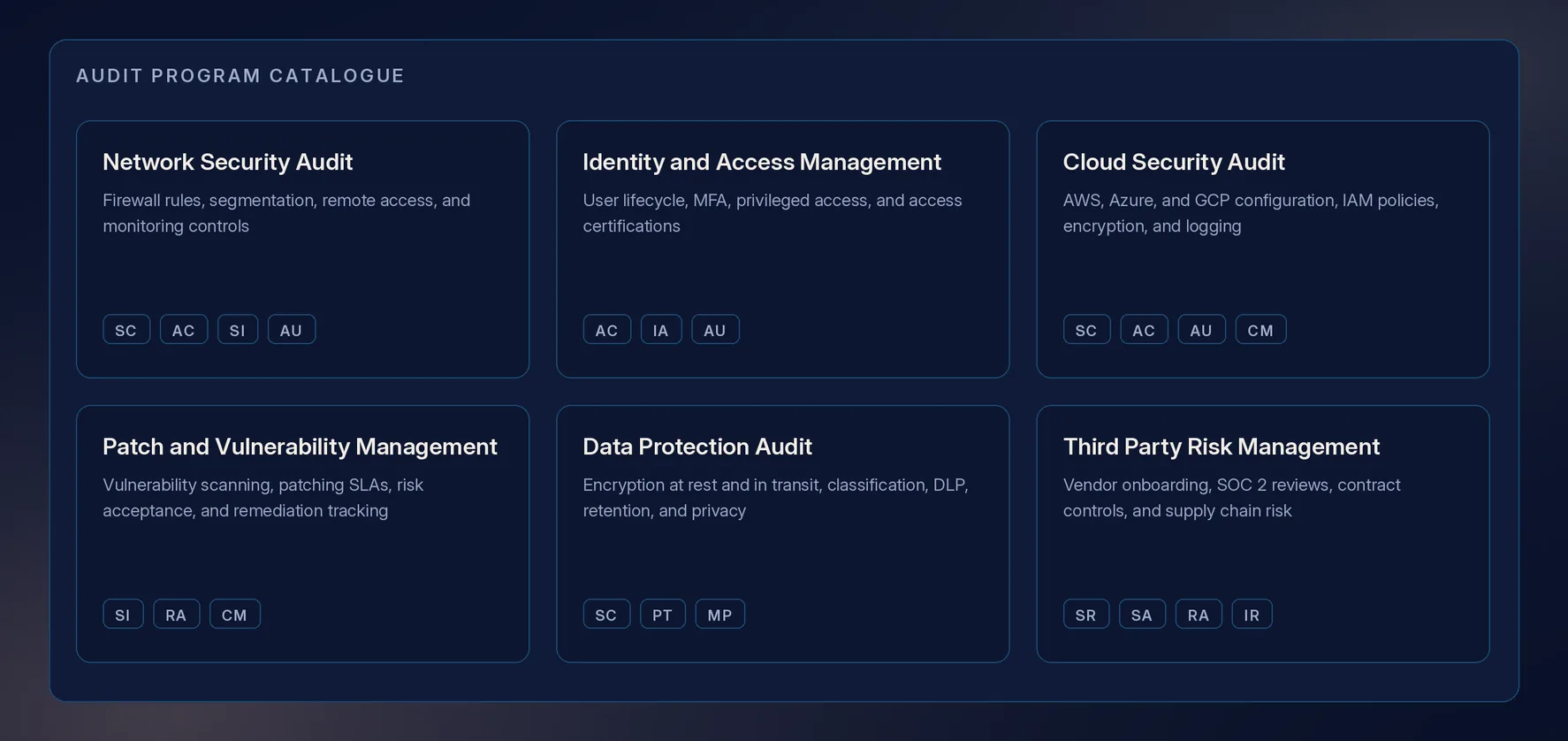
Naitra ships with ready audit programs for the recurring IT audit work, network security, identity and access, patching and vulnerability management, data protection, cloud security, and third party risk. Your team picks one and starts, rather than building the program from an empty document.
The audits you do not get to choose
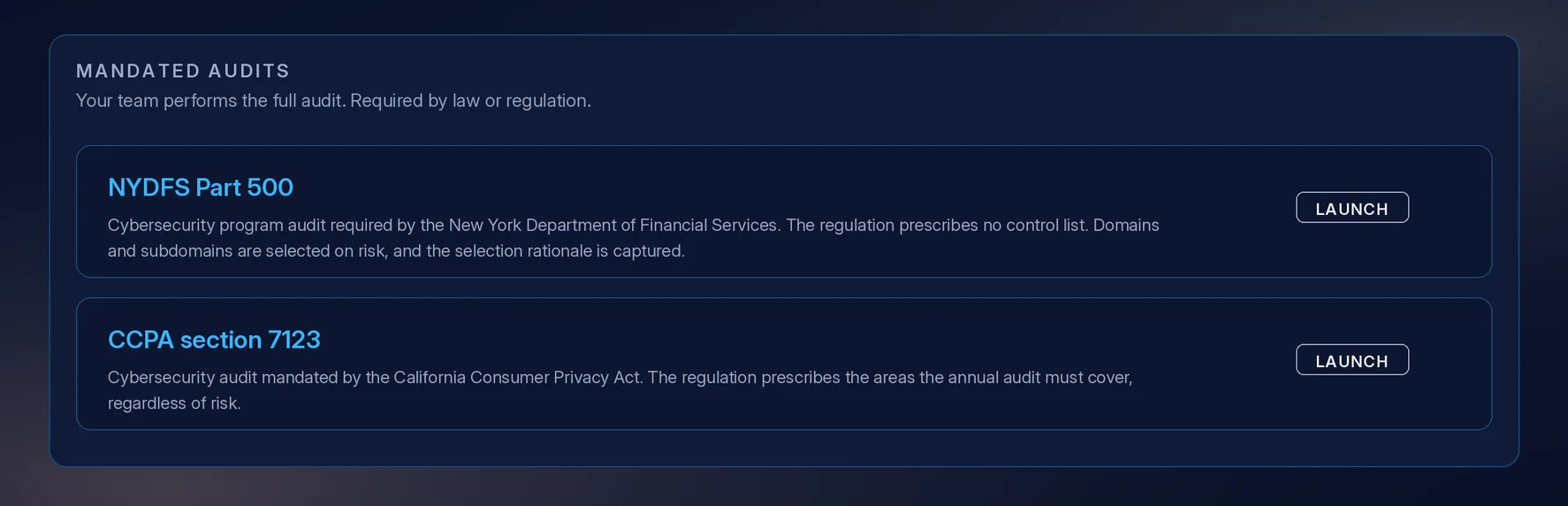
When a statute mandates the audit, Naitra runs it as a full engagement built from the statute itself. CCPA section 7123 and NYDFS Part 500 are both covered today. If your obligations change, the program follows the law rather than a generic mapping.
Built to the profession's new mandatory baseline
Conformance with the IIA's Topical Requirements is mandatory for assurance engagements on cybersecurity, and on third party risk from 15 September 2026. Naitra's audit programs are built to that baseline, control by control, so every engagement documents what was assessed and the rationale for anything excluded, exactly the way a quality assessment expects to see it.
Testing written for your exact technology, design in planning and operating in fieldwork
Naitra writes the testing approach for both design and operating effectiveness, tuned to the technology under audit. Design is tested in planning and operation is tested in fieldwork, as two separate tests on every control. A control that fails its design test does not move to fieldwork unless the auditor chooses to test operation anyway, to characterize the deficiency fully. The steps for an AWS review are not the steps for a mainframe, and conflating design with operating is how findings slip through.
Design, tested in planning: Would the control work as written? Naitra prepares the walkthrough, reads the control description, the configuration and the policy behind it, and lays out the design assessment for the auditor to conclude on, sample of one, current state.
Operating, tested in fieldwork: Did it actually run, throughout the period? Naitra tests the population across the whole period, names the sample and why it was drawn, and prepares the operating conclusion for the auditor to sign.
Evidence to workpaper to finding, with the auditor at every gate
Naitra maps each file to the control it tests, evaluates it attribute by attribute, and assembles the workpaper from the test. Your auditor corrects the mapping, signs the workpaper, and states the cause before a finding is raised. Nothing publishes on AI's word alone.

Report it to the board
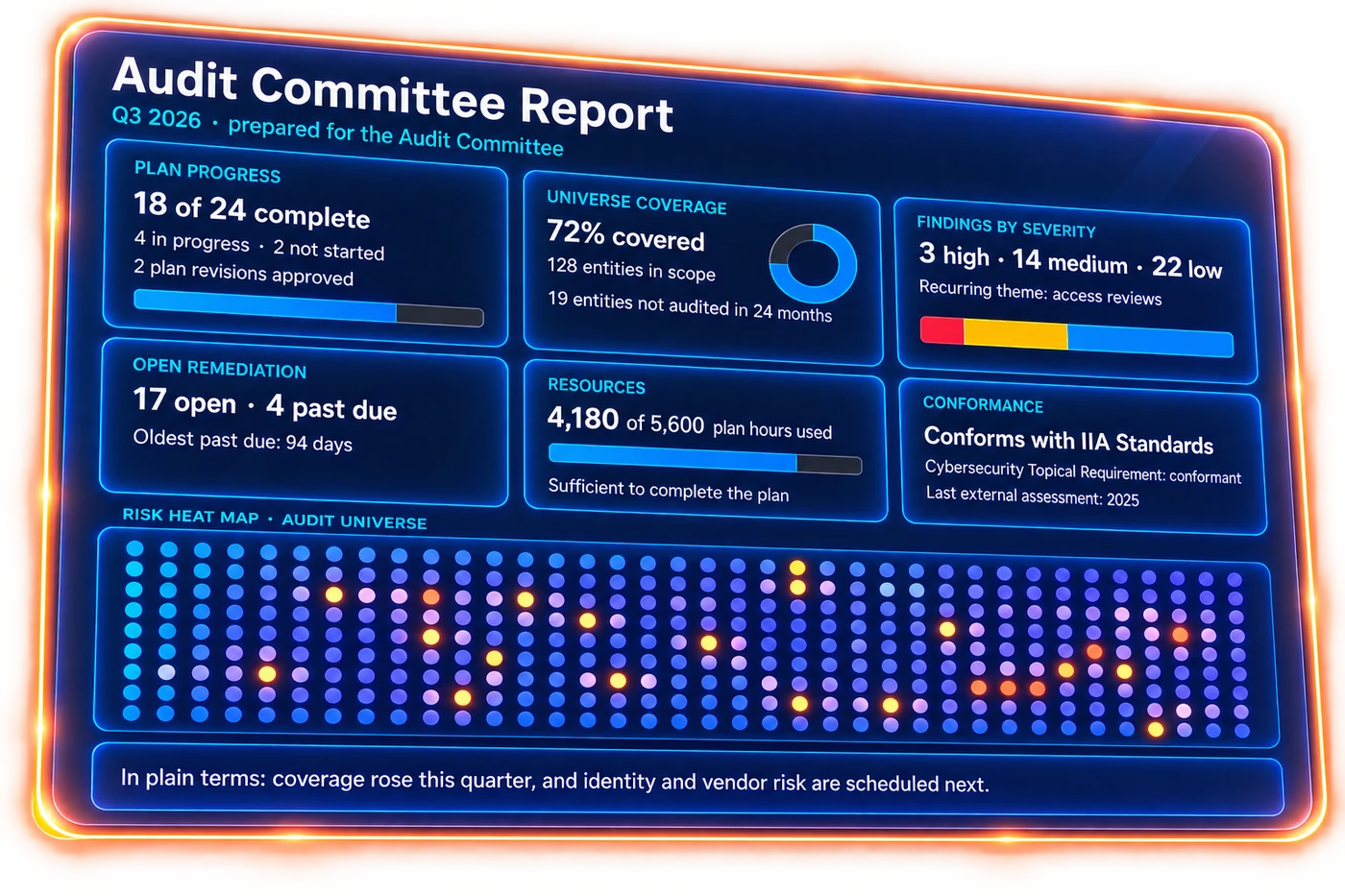
The whole picture becomes a board ready report: a risk heat map across your universe, coverage for the period, what changed since last time, and a plain language narrative the audit committee actually understands. No more rebuilding the deck the night before.
- A risk heat map across your whole universe
- Coverage, trends, and resource use at a glance
- A narrative in plain language, no audit jargon
The quarter, in the committee's language
The board report assembles from the engagements themselves: plan progress, universe coverage, findings by severity, open remediation, resource use, and conformance with the Standards. It closes with one plain sentence that a non auditor can act on.
The engagement report, in your company style
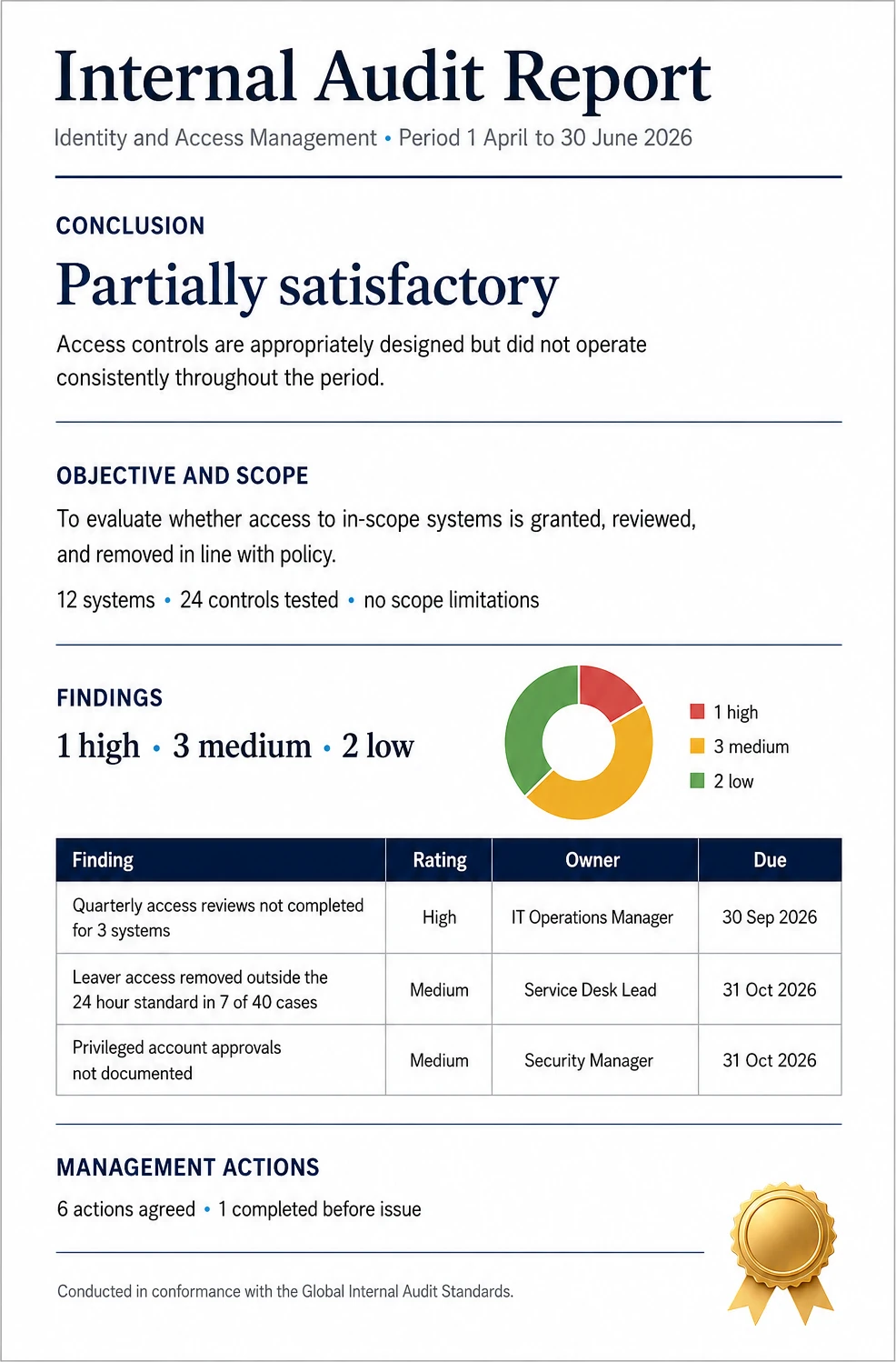
Naitra assembles the engagement into a finished report, findings, ratings, and conclusions, laid out in your format and branding. It looks like your team wrote it.
An engine, not a rip and replace
Every workpaper Naitra produces stands alone: what was tested, how it was tested, what evidence was examined, who prepared it, who sealed it, and the conclusion drawn. Download the engagement as one package and load it into whatever system of record you run today. Naitra does the audit work. Your GRC stays your GRC.
- One package: workpapers, findings, the matrix, the report, and a manifest
- Sealed by a reviewer who did not prepare the work
- Built to the IIA Standards and the Cybersecurity Topical Requirement

AI proposes. Your auditor approves. Always.
Naitra never publishes a conclusion on its own. It does the first pass, a person signs off, and the work is built to the standard a 20 plus year auditor defends to a regulator.
Every control traces to a named risk
A control with no stated risk is box ticking. Naitra states what goes wrong when the control fails before it tests a thing.
Design and operating, never collapsed
Design asks whether the control would work as written. Operating asks whether it ran throughout the period. Naitra keeps them separate, because conflating them is how findings slip through.
Every test names its population and sample
We looked at some is not an audit. Every procedure states the universe it drew from, the sample it took, and why.
Tested against the standard, not a template
Naitra builds its testing criteria from the frameworks themselves: the standard ingested, split into provisions, mapped to controls, and approved through auditor disposition before it tests anything. And where a standard is silent, Naitra does not quietly fill the gap with a generic default. The absence is surfaced as an audit issue, testing proceeds against best practice, and your auditor sees it and can change it.

The questions your security team will ask
Serious buyers run serious diligence. Here is how Naitra is built to meet it.
Full AI attribution
Every AI call is logged: who triggered it, when, which model, and the token usage. A complete, auditable record of the AI itself.
Content provenance
Every field carries a human, AI, or hybrid tag, with the model, the prompt, and the reviewer. The work shows its authorship.
Maker checker review
Workpaper review is separated from authorship and enforced in the workflow, not left to a policy on paper.
Tenant isolation
Your data never crosses into another customer's. Isolation is enforced in code on every query, not left to discipline.
Data handling per organization
Standard and HIPAA handling modes, set per organization in the AI routing layer. Customer data is never used to train models, and our AI provider retains it for no more than 30 days, as stated on our subprocessors page and in our data processing addendum.
No AI lock in
Naitra routes through a vendor agnostic layer. Adding or switching the underlying AI does not change your audit, your data, or your contract.
Most tools record the audit. Naitra executes the work.
Audit management systems are systems of record. They hold what you did, after you did it. Naitra runs the execution and leaves the record behind, in your hands, in a form your quality reviewer can follow.
You cannot conclude on a population you never verified
Information produced by the entity is a recurring quality review finding, and it is the one most often discovered after the conclusion has already been drawn. Naitra verifies the population before sampling, keeps that record durable, and blocks, not warns, a conclusion drawn from an unverified population.
Reproducible a year later
Every engagement records which control catalog version, which framework version, and which AI model produced which artifact. When someone asks in 12 months how a conclusion was reached, the answer is in the file, not in someone's memory.
Methodology cannot change quietly
A risk rating that drops a tier needs a reason and a name. Justifications are required and written to a signed trail.
Workpapers that seal, and travel
Sealed versions cannot be altered, each hash chained to the one before it, and exports carry the sealed state, so the record holds up outside the tool.
Coverage you can prove, not assert
Naitra measures your engagement against the IIA's topical requirements and shows what is covered, partial, or not covered at all.
Built by an auditor, not a committee

Munish Verma · Founder and CEO
Connect on LinkedIn
I started in technology risk two decades ago. There was always more to audit than we had hours for. I loved the work, and I watched the highest risks go unexamined, not for lack of skill, only for lack of hours. I built Naitra so the routine testing runs itself, and auditors spend their time on the risks no one has gotten to yet.
I have spent more than 20 years across technology and cybersecurity risk, spanning all 3 lines of the business. I started by implementing SAP and partnering with delivery teams to build controls into technology as it was built, worked in the second line across GRC and risk management, and have spent the majority of my career leading IT and cybersecurity audits in banking, insurance, healthcare, and technology. I am vice president of the Milwaukee ISACA chapter. Naitra is where that experience becomes software.
The beta is live. Be one of the first 3 teams to run it.
Naitra is in beta, and we treat you accordingly: the methodology and the workpapers are solid, some edges are still being straightened out, and we keep an open list of what we know. You work directly with the founder, run real audits from day one, and shape the product around the way your team works.
First in
3 seats, then closed until general availability.
Founder led onboarding
Your first audit run together, on a real engagement, in days not months.
Your feedback ships first
The features you need get built ahead of everything else.
All 3 open. First conversations starting now.
Talk to the founder directly
Email the founder, get a straight answer, and see Naitra run an audit on a live example. Bring your hardest audit.
Pricing is scoped to your audit function in the first conversation, no tiers, no modules, nothing held back.
Start a conversation →